Posts

Week 13

Image
The solar subteam has successfully built one of the two "ribs" that will support the solar panels.  The team is greatly indebted to Dan Espinoza, as he allowed the team to use his superior equipment to finish the job in a relatively short amount of time.  The solar team plans on repaying Dan by helping him finish his bogey design.

Week 12

The solar sub-team is really starting to come together at this point.  We all know our designated positions, and we are becoming more and more efficient at dealing with problems.  I was personally the main designer of the physical structure, as well as the locator of the materials for the main racking structure.  Charles took charge of the electrical components, and he was also responsible for most of the team's financial documentation.  Updating the bill of materials, contacting vendors, and making purchases were all part of his responsibility.  Tan took charge of the CFD analysis that the team is tasked with completing.  Tan was also the team's equipment specialist, as he is more familiar with the Superway shop than the rest of the team.  Of course, the entire team came together to accomplish certain tasks, such as physically building the structure, as well as brainstorming solutions to problems.

Week 11

The team has come up with a solution to the issue of the self-tapping screws.  Using a drill press, the team was able to drill a hole straight through both the channel and the gusset plates that were purchased the previous week.  After drilling a hole of a radius that is slightly smaller than the purchased screws.  The screws are than easily able to penetrate the both the metal channel and the gusset plates.  The team has spent a good number of hours at the shop at this point, and the fabrication process is starting to go faster, which is a good sign.

Week 10

The team has made major purchases and is currently in the middle of the fabrication process.  While cutting the steel channels has proved to be a relatively easy experience with the use of a chop saw, drilling into the steel channels has proved to be a much more difficult process.  Dr. Furman advised the team to use self-tapping screws for ease of use, as self-tapping screws should require no pre-drilled threads, as the screws tap themselves.  However, the process is proving to be more difficult than expected.  Even while using a hammer drill, the screws are having difficulty piercing the Unistrut channel.  The issue lies in either the drill, the screws, or the channel, and the team is in the process of figuring out which one is the problem.

Week 9

My group partner Charles has contacted Lord and Sons and informed them of our order placement.  Lord and Sons have replied that the order should be available for pickup on March 26th, or the first day of Spring Break.  It appears that the majority of the majority of the solar team's Spring Break will be spent in the Superway shop, figuring out fabrication details.

Week 8

The team has decided that the best course of action for purchasing materials is to rent a twenty six foot U-Haul truck to move the twenty foot sections of channel that will be purchased from Lord and Sons.  The team may also stop to make other purchases, such as the gutter filtration system, from a store like Lowes or Home Depot.  The team is currently planning on doing most of the fabrication in the shop, so the team will have to learn what tools are available and how to use them.

Week 7

The new design has been approved by Dr. Furman, and the team has started making preparations for purchasing materials.  The team is currently discussing the best way to move necessary materials to the shop.  Lord and Sons, the distributor through which the team is planning on purchasing the majority of building materials through, charges an $800 shipping fee, which is no small amount.  The team may end up renting a large truck to move necessary materials, rather than pay the freight shipping charge.

Week 6

My teammates have made some good progress.  While I designed the racking structure, Tan worked on the gutter helmet design, while Charles worked on the wind-loading analysis.  There is currently a small amount of confusion with regards to producing shop drawings.  As far as my own knowledge, there are two sets of shop drawings that need to be produced: the shop drawings for fabrication that are going to be sent out to companies, such as Vander-Bend, and the shop drawings that are going to be sent to Futran for further evaluation.  The solar team is not currently planning on hiring help with regards to fabrication.  Other teams, such as the track team, are using outside vendors to help with fabrication processes, and require detailed shop drawings to do so.  I have personally never had to produce a detailed shop drawing, so this should be an interesting learning experience.

Week 5

I think we finally have it! Dr. Furman sent out an email a few days ago, detailing what he believes to be the most optimized design.  Using Solidworks, I made a design that very much matches his requirements in his drawing. If he has time today, I will show him my design, and he will hopefully approve it.

Week 4

The team has been making more design changes and has been preparing for the first presentation of the semester.  I have been personally making most of the design changes, as it is getting more and more difficult to trust some of my group mates with different tasks.  The overall racking structure is almost complete, the team just needs to worry about the gutter helmet fitting.

2nd Semester, Week 3

Image
The team has made yet another design that features a canopy and a middle trussing component.  The solar team believes that this design will be optimal due to the fact that wind loading will be decreased due to the gaps in the design.  However, the current design is still undergoing changes. 

2nd Semester, Week 2

There has been more design iterations that I have been working on for the team.  The current design was made to be compatible with up to 8 solar panels that can either 1m x 2m or 1m x 1.66m.  Dr. Furman suggested implementing a truss design to ensure the stability and strength of the design.  The team is currently scrambling to get designs approved in order to begin ordering parts and planning the scope of work.

2nd Semester, Week 1

There has been some ongoing discussions on the possibility of changing the proposed 9 meter section of track to 3 meters to save on material costs.  Currently, the proposed combined budget of the full scale solar, bogey, and track teams is north of ten thousand dollars.  If this proposed change is agreed to, the solar team have the unique challenge of implementing standardized solar panel sizes of 1 m x 2 m or 1 m x 1.6 m to a track that is approximately 3 meters in length.  The solar team is currently reworking designs for implementation.

Week 10

Image
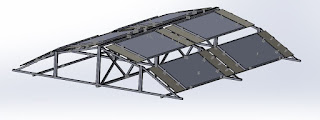
I have been spending a whole lot of time in the past week using Solidworks to make a good model of the truss design.  I'm personally not too experienced with Solidworks, so a bunch of my time has been spent trying to learn the software.  Below is a simple sketch that I made of our base truss design.  I'm currently in the process of making all of the different linkages that will go into the final assembly.  I'm trying to leave spaces in the open gaps of the truss for our solar panels, but right now I'm a little confused on some of the dimensions of the available panels that we have to work with.  I'm going to take all the dimensions of the available solar panels again, as soon as I get back into the shop.

Week 9

Charles, a member of my group, recently informed the rest of the team that Dr. Furman and Ron do not believe that our "shell" design for the solar racking system will be a feasible thing to do with the limited time and resources that the solar team currently has.  The solar team will now dedicate the rest of the semester towards having a much simpler design that will be guaranteed to work.  After ensuring that the base design is perfect, the team will be free to chase more ambitious, less guaranteed to work designs.  The simple base design that the team will make will be based off of drawings received from South Africa.

Week 8

Image
The full-scale track, bogey, and solar teams will now have regular meetings where progress is discussed in a group setting.  Details involving the track and certain design elements were discussed in the previous team meeting.  The 9 meter track will consist of two "L" beams to support the straight section, and one "T" beam to support the switch, as seen in the figure below.  The solar team has decided to implement a truss design to support the racking of the solar panels.  The truss will support a "shell" that will be configured with the needed solar panels.  The figure below does show the truss design, but not the shell, as the team is still in the process of designing that specific part.

Week 7

Preparations are currently being made for the next group presentation, which is in approximately one week.  Points were lost in the last group presentation for not having adequate project specifics and not using the assertion-evidence method for some of the slides.  The group is going to make every effort to ensure that points are not lost again on these specific sections.  The 2nd presentation will be very similar to the 1st presentation, with the biggest difference being that the 2nd presentation will request that the team have a plan for "dependencies and contingencies." The team will meet throughout the week to make sure that the presentation is completed on time.

Week 6

Image
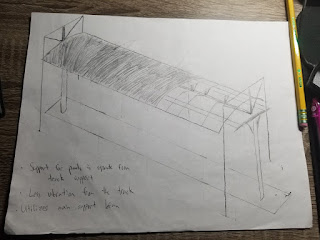
I made another sketch based off of a design that Dr. Furman showed the solar team.  For this design, the support for the panels is not connected to the track at all and instead stands on it's own support beams.  I left the latter half of the track uncovered by the panels so that people could see the main support beam.  In my opinion, the best aspect of this particular design is the fact that vibrations and movements caused by the cars on the track will have much less effect on the solar panels stability, due to the fact that the racking for the solar panels is a completely separate entity from the track support.

Week 4

A presentation was given today that demonstrated the progress of the design phase for several different full-scale and half-scale teams.  The teams showed off different design concepts, as well as the pros and cons of those design concepts.  The presentations also included expectations for challenges in the future and also a final design concept that each team believed to be ready for prototyping.  The presentations took most of the allotted class time, but there was still some time left for questions in the end.  The recently returned Africa team showed off some of their design concepts based off of the Futran system and was able to give advice on what they believe to be the final design.

Week 3

Image
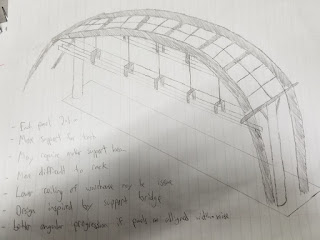
Most of today's time was spent conversing with Dr. Furman and Eric about the potential designs for the racking of the panels.  A possible new design that utilizes the racking as support for the entire track was discussed.  Details about the presentation that is due the next class were also discussed.